The Quality of AI Predictions Depends on the Quality of Human Data
Artificial Intelligence has transformed how brands analyze and forecast market outcomes. Yet despite massive advances in LLMs, most organizations still struggle with making the right decisions.
Why AI Needs Subconscious Data to Predict Human Behavior
Brands are investing heavily in AI to predict which products will succeed, which ads will perform, and how consumers will respond to new ideas. Yet many predictive models are trained on data that only captures what people say and do—not what truly drives their decisions.
The reality is that human behavior is not purely rational.

Behavioral science has long shown that decision-making is influenced by both conscious reasoning (System 2) and subconscious, emotional processing (System 1). While most research tools focus on surveys, clicks, views, and other conscious behaviors, these metrics often miss the non-conscious signals that influence real-world choices. This is where predictive AI faces a challenge.
If AI is trained primarily on rational, self-reported, or historical data, it can struggle to understand the emotional and subconscious factors that drive behavior. As a result, brands may accurately predict what consumers think but fail to predict what consumers will actually do.
Understanding behavior requires measuring multiple dimensions of human response, including attention, emotional expression, memory, desire, implicit perceptions, and stated consumer feedback. These signals are collected in-context as consumers naturally engage with advertising and content, creating a more complete picture of decision-making.

- Eye Tracking to understand what captures and holds attention
- Emotion AI to identify moments that generate positive or negative emotional reactions
- In-Context Stopping Power and Decay Rate measures to determine whether content stands out or is chosen within a social media or commerce application

- Depth of Memory to measure subconscious brand recall
- True Implicit Associations to identify changes occurring beneath conscious awareness that influence buying decisions
- Consumer Voice measures that capture conscious opinions and preferences
These behavioral signals are anonymized and stored within Sentient’s Behavioral Data Lake, creating a continuously expanding repository of real human decision-making data that can be used to train predictive models and AI systems.
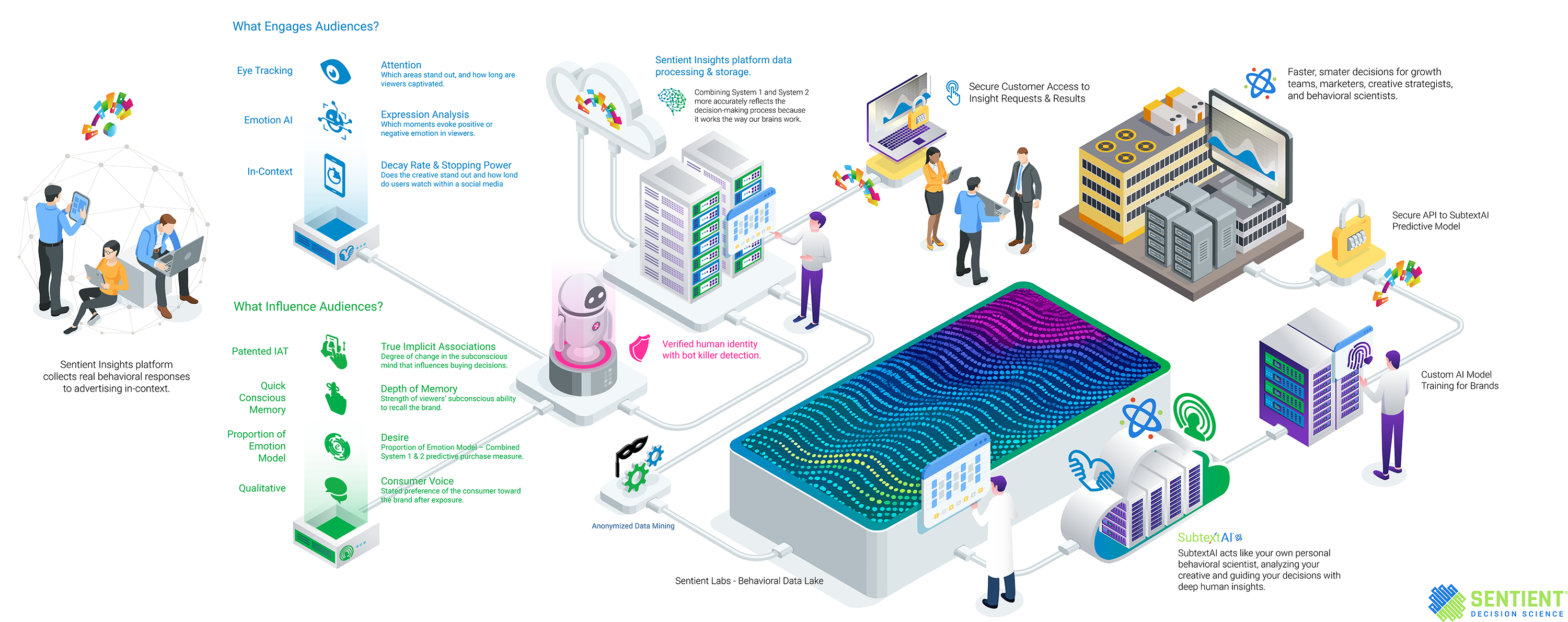
One of the most important components of this approach is the Proportion of Emotion Model. Rather than relying solely on rational survey responses, the model combines System 1 and System 2 measurements into a predictive purchase metric. By weighting subconscious emotional appeal alongside conscious evaluation, it provides a more accurate reflection of how humans actually make decisions.
This distinction is critical because consumers frequently behave differently than they claim they will. A person may consciously state that price drives their purchase decision while subconsciously responding to emotional cues, brand familiarity, memory, or social signals. Traditional data often misses these influences, while behavioral measures can capture them directly.
The implications for AI are significant.
As brands increasingly rely on synthetic data and LLMs to generate suvey responses or forecasts ad performance, the quality of those predictions depends on the quality of the human data used for training. AI trained on richer behavioral data learns not just what consumers did in the past, but why they made those decisions in the first place. The result is better forecasting, more accurate creative evaluation, stronger synthetic audiences, and a deeper understanding of diverse consumer groups.
The future of predictive AI will not be defined solely by more models or more data. It will be defined by access to richer, more sensitive measures of human behavior. When brands combine rational data with subconscious behavioral signals, they move closer to answering the question that matters most:
What will consumers actually do?
That is the advantage of AI powered by behavioral data, enabling organizations to improve predictive accuracy and confidently make better business decisions faster.

By: Jeremy Clough
SVP Brand & Product Strategy

Mind the Gap: Where Ecosystems Miss 50% of Human Behavior
Last month, Sentient's Dr. Aaron Reid joined host Dyan Finkhousen on the Ecosystemic Futures podcast to discuss the hidden drivers of decision-making. Dr. Reid first introduced himself, explaining his personal and professional interest in...
Emotional Connection: Why GenAI Needs Continuous Insight Into Real Human Behavior
Who wants to be average? On Monday, May 19th Sentient's Dr. Aaron Reid addressed this question on stage at FEI. As Generative AI becomes a standard tool for rapid consumer insights, it's important to remember that past preferences aren't indicative of...

Sentient to Present on the Future of AI & Human Insight at FEI
EVENT ANNOUNCEMENTDr. Aaron Reid will demonstrate how continuous AI-powered testing enhances the precision and depth of insight into human desire.EVENT TICKETSFront End of Innovation 2025Event Overview Sentient Decision Science will be attending the...

155 Fleet St.
Portsmouth, NH 03801